BIO 004 · Human Anatomy
The Language of Anatomy
Introduction to Anatomy
A reference for the anatomical terminology video and lab. Every position, plane, direction, and region named here is the shared vocabulary the rest of the course is built on.
How to use this sheet
Notes prints the full reference for review.
Study prints as a fill-in-the-blank worksheet to complete while you watch the video or read.
Quiz me is on-screen practice: type the term, or click Reveal to check yourself.
The tables and sequences respond to Study and Quiz too, with a Reveal button on each row.
- List the six levels of structural organization in order.
- Place the body in anatomical position and explain why it is the reference for every directional term.
- Name the planes and sections and use the paired directional terms precisely.
- Identify the major anterior and posterior regional terms and sort them as axial or appendicular.
Your pre-work
Work through these the evening before class. None of it is turned in. It is how you learn the material and build your spaced recall.
This is more than a checklist. Ticking these boxes is the start, not the finish. Committing this material to memory and being able to apply it takes considerable time and repeated effort. You are not done when the boxes are checked. Put in the real hours, and keep coming back for frequent recall and review until the material is genuinely yours.
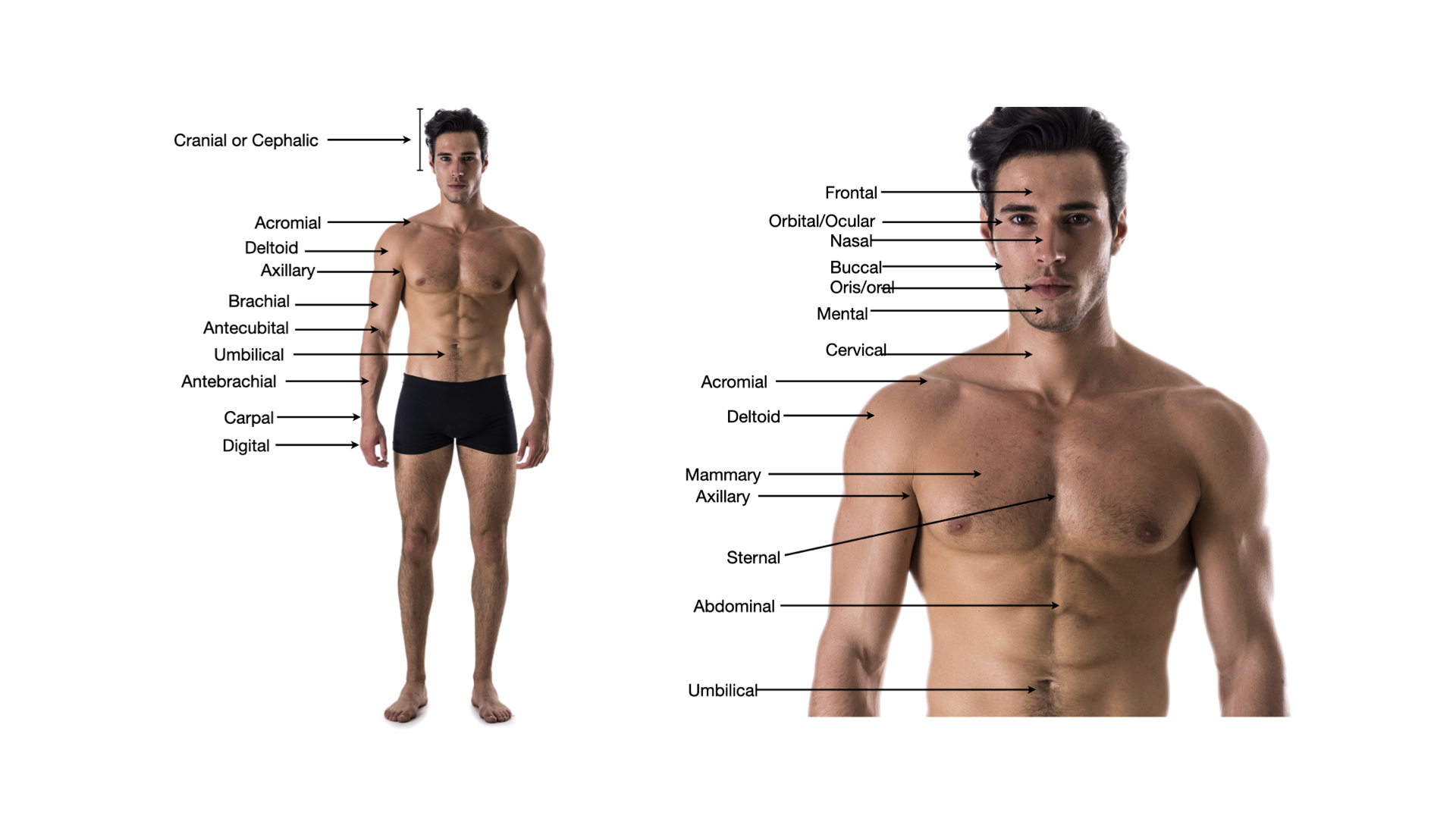
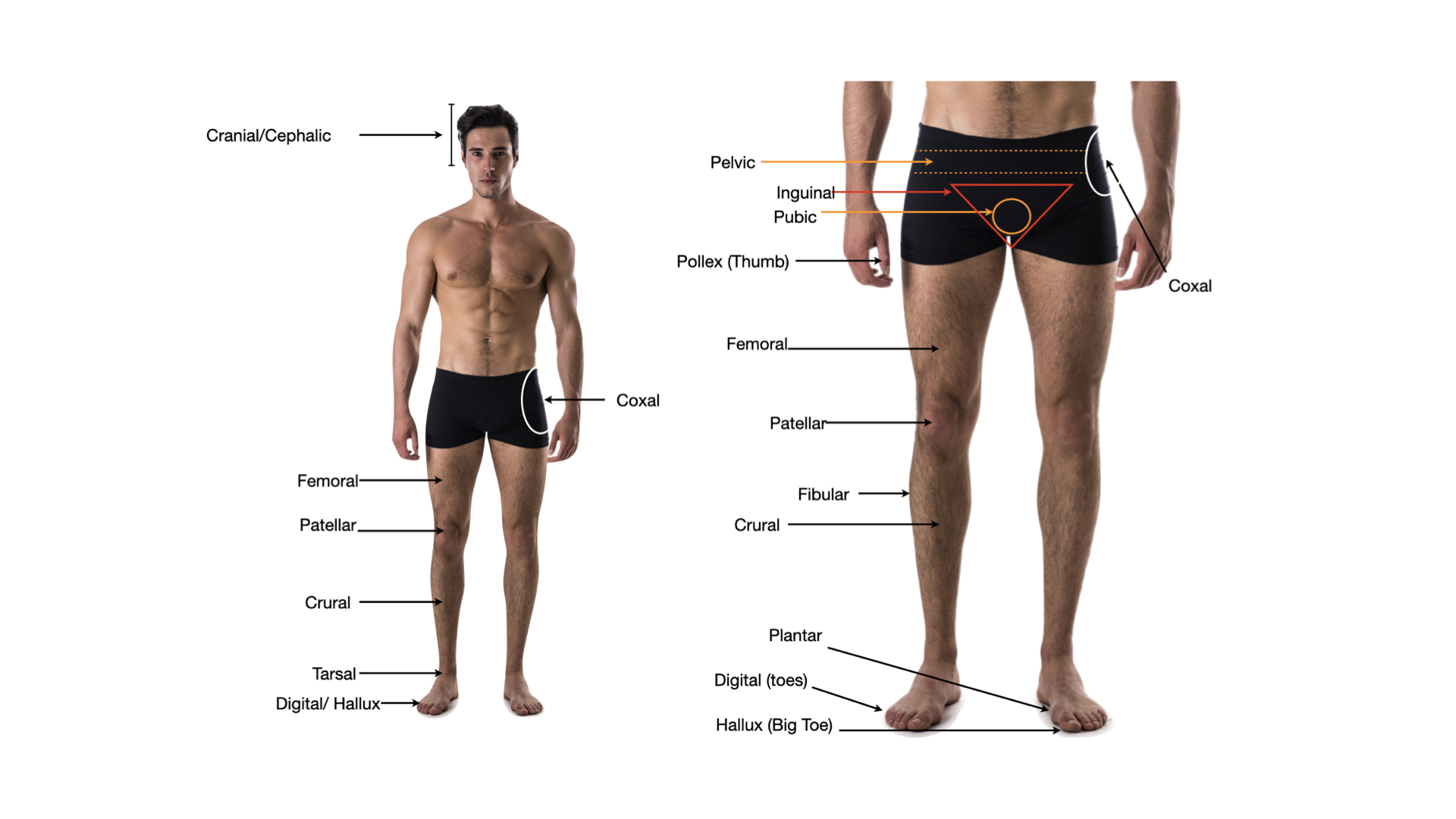
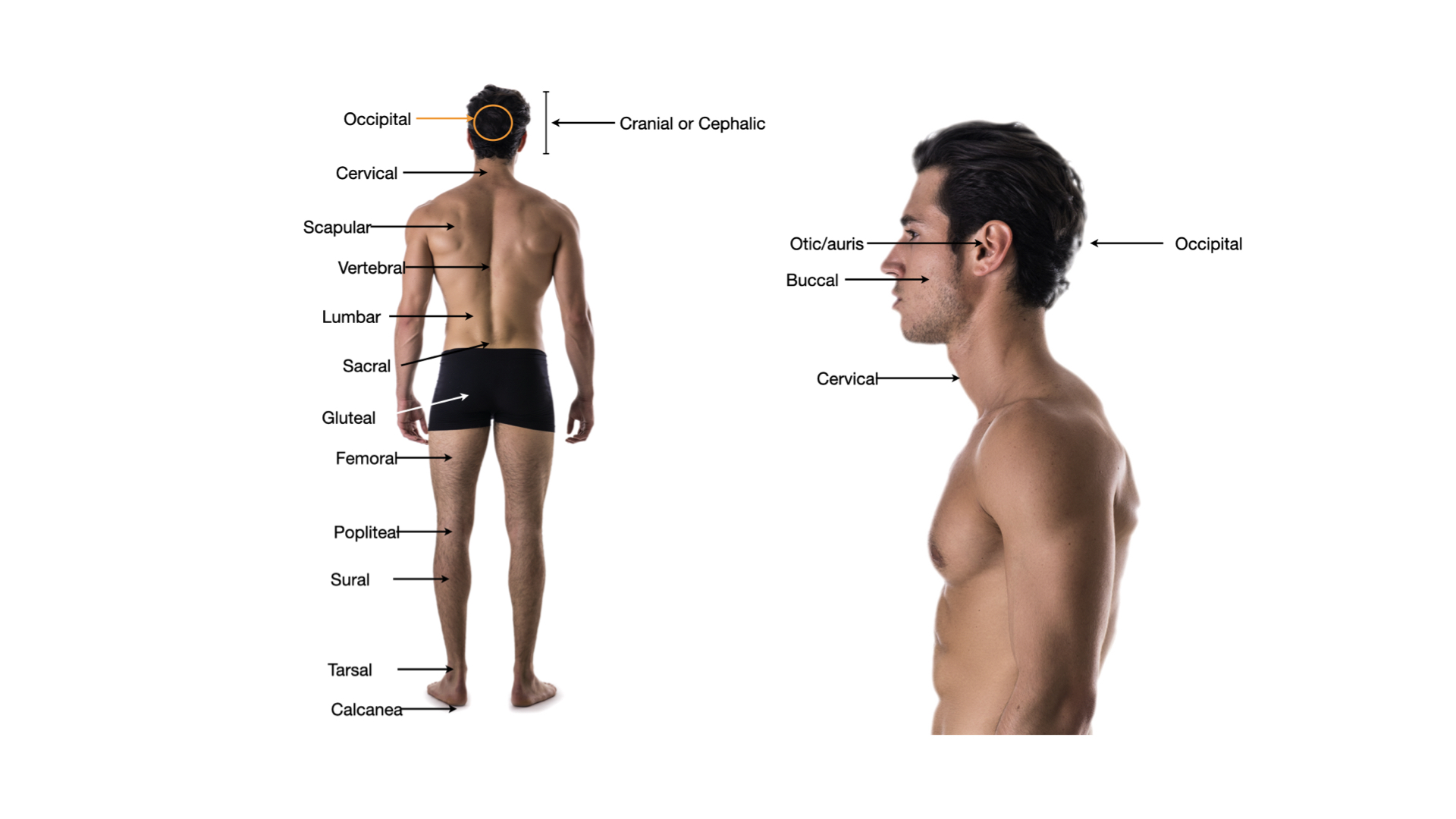
Click any image to enlarge.
Levels of Structural Organization
The body is organized from the simplest level to the most complex. Each level is built from the one before it.
- Chemical levelatoms and molecules, the smallest level
- Cellular levelcells, the smallest living units of the body
- Tissue levelgroups of similar cells working together on a shared task
- Organ leveltwo or more tissue types forming a structure with a defined job
- Organ system levelorgans that cooperate toward one broad function
- Organismal levelall organ systems together, the living person
Anatomical Position
- Anatomical positionbody erect, feet flat and slightly apart, head and eyes facing forward, arms at the sides, palms facing forward
- Why it is the referenceevery directional term assumes this position, so a description never changes with how the person is actually standing or lying
- Supinelying face up, on the back
- Pronelying face down, on the front
Body Planes and Sections
A plane is a flat surface that slices the body. The section is the cut surface it produces.
| Plane | Orientation | Divides the body into |
|---|---|---|
| Sagittal | vertical | right and left parts |
| Midsagittal (median) | vertical, on the midline | equal right and left halves |
| Parasagittal | vertical, off the midline | unequal right and left parts |
| Frontal (coronal) | vertical | anterior and posterior parts |
| Transverse (horizontal) | horizontal | superior and inferior parts, a cross section |
| Oblique | at an angle | parts at an angle, between horizontal and vertical |
Directional Terms
Directional terms come in pairs of opposites, always given from the patient's perspective in anatomical position. A structure between a medial and a lateral one is called intermediate.
| Term | Its opposite | The relationship the pair describes |
|---|---|---|
| Superior | Inferior | above versus below, toward the head or toward the feet |
| Anterior (ventral) | Posterior (dorsal) | toward the front versus toward the back of the body |
| Medial | Lateral | toward the midline versus away from the midline |
| Proximal | Distal | nearer versus farther from the trunk, used for the limbs |
| Superficial | Deep | toward versus away from the body surface |
| Cranial | Caudal | toward the head versus toward the tail end |
| Ipsilateral | Contralateral | on the same side versus the opposite side of the body |
Regional Terms
The body divides into an axial region, the head, neck, and trunk, and an appendicular region, the limbs. Each named region has a precise term.
Axial regions
- Cephalicthe head
- Frontalthe forehead
- Orbitalthe eye
- Nasalthe nose
- Oralthe mouth
- Buccalthe cheek
- Mentalthe chin
- Oticthe ear
- Occipitalthe back of the head
- Cervicalthe neck
- Thoracicthe chest
- Sternalthe breastbone
- Mammarythe breast
- Abdominalthe belly
- Umbilicalthe navel
- Vertebralthe spinal column
- Lumbarthe lower back
- Sacralbetween the hips, over the sacrum
- Glutealthe buttock
- Pelvicthe pelvis
- Inguinalthe groin, where the thigh meets the trunk
Appendicular regions
- Acromialthe point of the shoulder
- Axillarythe armpit
- Brachialthe arm, shoulder to elbow
- Antecubitalthe front of the elbow
- Olecranalthe back of the elbow
- Antebrachialthe forearm
- Carpalthe wrist
- Manusthe hand
- Palmarthe palm
- Pollexthe thumb
- Digitalthe fingers or toes
- Coxalthe hip
- Femoralthe thigh
- Patellarthe front of the knee
- Poplitealthe back of the knee
- Cruralthe leg, knee to ankle
- Suralthe calf
- Fibularthe lateral side of the leg
- Tarsalthe ankle
- Calcanealthe heel
- Pedalthe foot
- Plantarthe sole of the foot
- Halluxthe great toe
Build the word
Term breakdown
Anatomical terms are assembled from Greek and Latin roots. Learn the pieces and you can decode terms you have never seen before, which is the whole point of the vocabulary.
- ante- / anter-before, toward the frontanterior, antecubital, antebrachial
- poster-behind, toward the backposterior
- super- / supra-above, oversuperior, superficial
- infer-below, underinferior
- proxim-nearestproximal
- dist-distant, awaydistal
- medi-middlemedial, intermediate, median
- later-sidelateral, ipsilateral, contralateral
- cephal-headcephalic, encephalon
- caud-tailcaudal
- ipsi- / contra-same / oppositeipsilateral, contralateral
- trans-acrosstransverse
- brachi-armbrachial, antebrachial
- crur-leg (knee to ankle)crural
- -al / -icpertaining to (suffix)brachial, cephalic
See also: Body Cavities and Regions, the companion page in this module.
Draw it from memory Sketch and label before you check
Work on blank paper, from memory, before you look back at the figures. Drawing forces you to commit the spatial relationships, not just recognize them.
- Draw a simple body outline in anatomical position. Add a line for each of the three reference planes: sagittal, frontal, and transverse. Label each plane and name the two parts it divides the body into.
- On the same figure, draw and label arrows for the paired directional terms: superior and inferior, anterior and posterior, medial and lateral, and (on a limb) proximal and distal.
- Draw an anterior and a posterior whole-body outline. From memory, label at least ten axial and ten appendicular regional terms in their correct locations.
Then check yourself. Compare your labels against the figures and tables above. Whatever you missed or placed wrong is your study list for tonight. Redraw it until it comes out right without looking.
Study questions
Work on answering these in writing, in your own words. They are the questions to bring to class, and good practice for the reasoning the exams ask for.
- Why is anatomical position the agreed reference for every directional term? What goes wrong without it?
- A wound is charted on the proximal, lateral left forearm. Describe where that is, and explain why proximal and distal are used for limbs but not the trunk.
- Compare the sagittal, frontal, and transverse planes. For each, name the two parts it divides the body into.
- Sort these as axial or appendicular and state your rule: brachial, thoracic, popliteal, vertebral, carpal.
- Walk through the six levels of structural organization and explain how each is built from the one before.
Step 2 . Retrieval check
Now explain it back, in your own words.
In 60 words or more, pull together what the video just taught you. Include the key concepts. This is the point where the learning actually sticks. After you submit, your spaced-recall cards for this topic unlock.